
What is Syntax?
--and why does it matter?

Syntax is the way words are arranged to make a well-formed sentence. It becomes interesting once you realize that there are multiple ways to formulate the same idea:
The boy kicked the ball
The ball was kicked by the boy
In this sentence, boy is the noun, kicked is the verb, and the ball is the direct object. Syntax is a sub-field of grammar, and yes—it can be studied as a very boring and technical thing. But if you pay close attention, sometimes you’ll hear a sentence that is really interesting because the syntax is unusual.
Consider the first two lines of one of Emily Dickinson’s poems:
Tell all the truth but tell it slant —
Success in Circuit lies
Sometimes, specific word choices play an interesting part in syntax. The word slant there is used as an adverb, which is very unusual. But it’s the second line that stumps people the first time they read this: “Success in circuit lies.” To understand it, you have to slow down and understand the possible meanings she is presenting.
If the second line is meant to reinforce the first line, which I think it is, then what Dickinson means is: “You will be successful speaking truth if your success is attained in circumlocution, in speaking around what you want to say.” She might have said, “Success is found in circuitousness,” or “success lies in being elusive.”
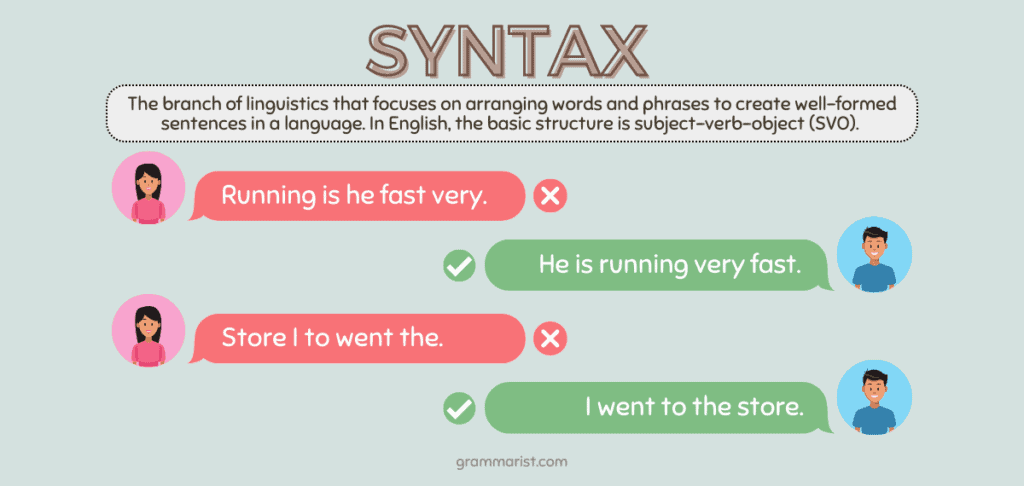
One other interesting example: if you ever watch Star Wars, Yoda was famous for using non-standard syntax: he would say “strong, you are” rather than “you are strong.”